
Home Daycare Business Plan
A Home Daycare Business Plan is a strategic roadmap for operating a licensed Early Childhood Education (ECE) facility within a residential property. Unlike a commercial center, it leverages residential zoning to achieve significantly higher profit margins through lower overhead.
Is it a Business or a Job?
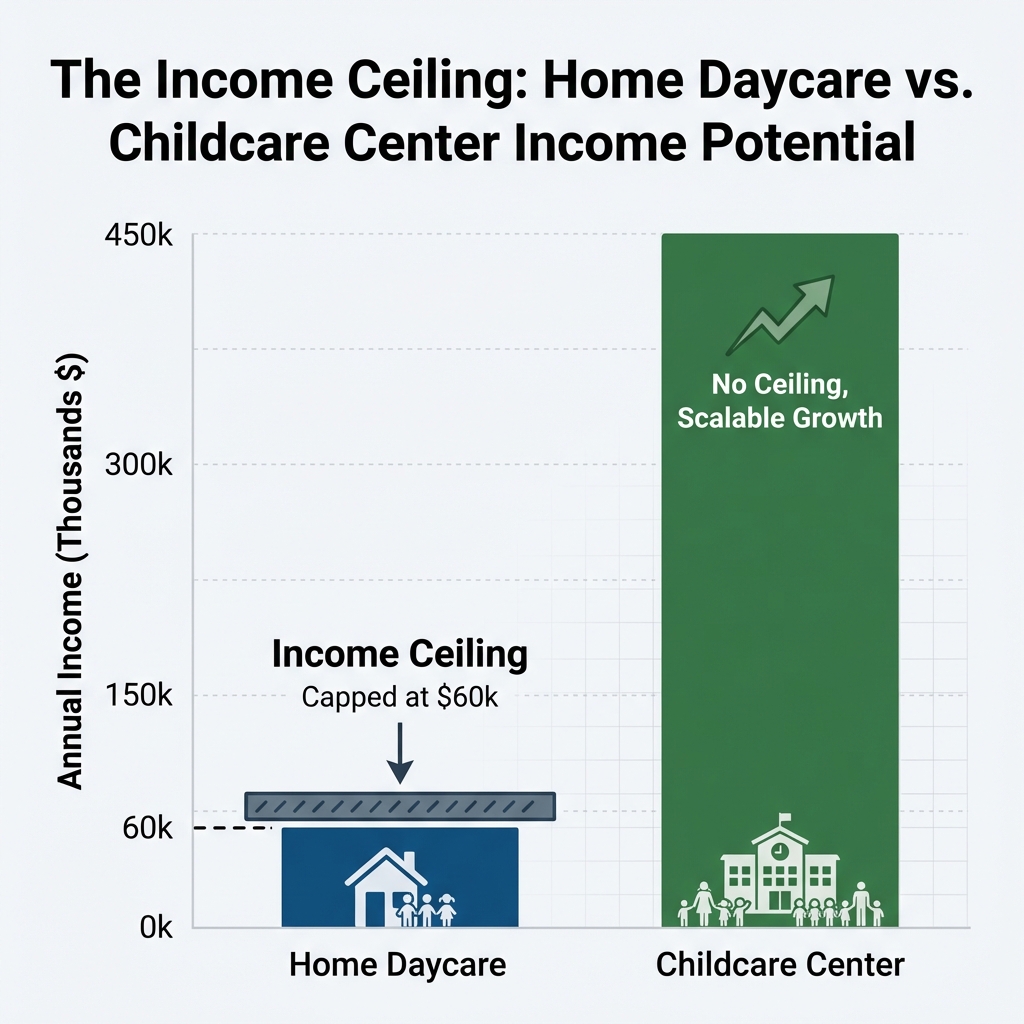
The most common misconception in 2026 is that a home daycare is just a “job” that caps out at a low salary. This is only true if you operate with a standard license.
When structured correctly as an asset, a home daycare offers superior unit economics to a commercial center. While commercial centers often operate on thin 10-15% net margins due to heavy rent and staffing loads, efficient home daycares in 2026 frequently see profit margins of 25-40%.
The difference isn’t the model; it’s the license.
The “Scale Trap”: Why Small Licenses Fail
Most aspiring owners default to the standard “Small Family Child Care” license, which typically limits capacity to 6 children.
This creates a “Scale Trap.” With only 6 tuition spots, your revenue is mathematically capped. Even with premium rates, the income often resembles a median salary rather than business profit. You have created a job for yourself, but you haven’t built an asset that can scale.
The “Large License” Leverage
The industry’s best-kept secret is the Large Family Child Care Home (LFCCH) license.
Contrary to the “6-child limit” myth, major states like California, Illinois, and Colorado allow home providers to care for 12 to 14 children when hiring a qualified assistant.
- Small License: ~6 Children (Solopreneur)
- Large License: ~12-14 Children (Micro-Enterprise)
By moving to a Large License, you effectively double your revenue potential while your fixed costs (mortgage, utilities) remain largely the same. This implies that the second half of your enrollment is almost entirely pure profit.
The Revenue Gap
The financial difference between a Small License and a Large License isn’t just incremental; it’s exponential.
In many states, maximizing a Large License shifts the business from “supplemental income” to “executive-level revenue.” However, the regulations for unlocking this tier—such as square footage, fire clearance, and assistant ratios—vary wildly by zip code.
Some states cap you strictly at 10. Others allow 16 with two assistants. If you build your business plan on the wrong number, you are leaving 50% of your potential revenue on the table.
Conclusion: The Micro-Center Opportunity
The “Large License” strategy transforms a humble home daycare into a high-margin micro-enterprise. It is one of the most efficient business models in the entire care economy.
If you can navigate the regulatory requirements to unlock this capacity, you aren’t just “watching kids in your living room.” You are running a serious, scalable asset that provides executive-level income with residential-level overhead.