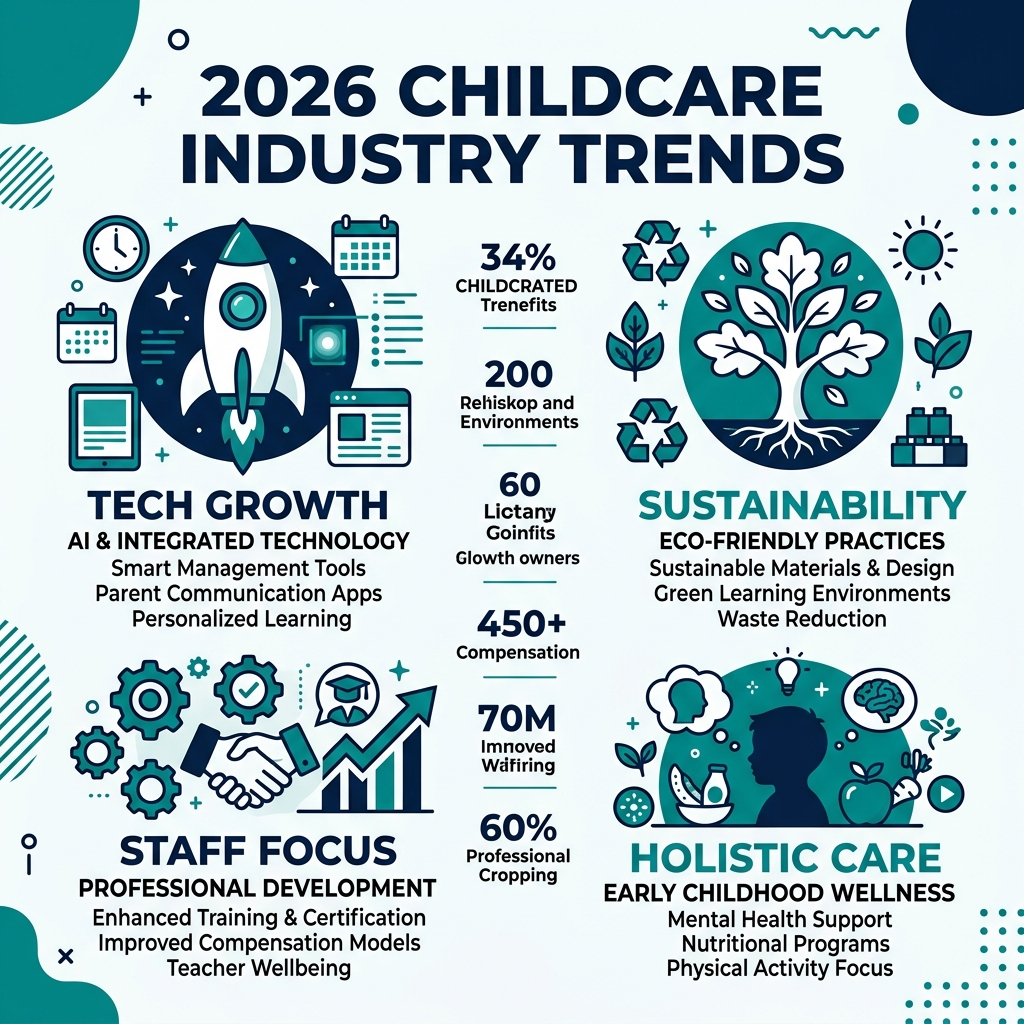

Stop Ignoring Childcare Industry Trends
Most childcare operators treat industry news as background noise, assuming their local market is static. This assumption is costing you immediate growth; failing to adapt to documented shifts in parental demand or regulatory changes can easily erode $10,000 in potential annual profit per classroom.
Why Trend Analysis is Non-Negotiable for Profit
Effective trend analysis moves you from reactive management to proactive financial steering. It dictates where you allocate capital and staffing resources for maximum return.
1. Aligning Program Offerings with Demand
- The Utility: Identifying which age groups or specialized programs (e.g., STEM focus, extended hours) are seeing the highest parental spending increases.
- The Value: Centers that pivot quickly to high-demand, underserved niches report 20% faster waitlist growth than their competitors.
2. Navigating Regulatory and Subsidy Shifts
- The Utility: Understanding forthcoming changes in state subsidy reimbursement rates or mandated staff-to-child ratios before they become law.
- The Value: Early compliance adjustment avoids steep fines and ensures you capture the full 100% of eligible reimbursement funds immediately upon implementation.
3. Benchmarking Operational Cost Structures
- The Utility: Comparing your utility, insurance, and payroll percentages against industry benchmarks for centers of similar size and location maturity.
- The Value: Identifying that your insurance spend is 8% above the regional median allows you to renegotiate or switch providers, saving thousands annually.
4. Predicting Staffing Volatility
- The Utility: Monitoring regional labor market data to anticipate when teacher turnover rates will spike due to competing sector hiring or local wage floors increasing.
- The Value: Proactive retention bonuses based on forecasted volatility can reduce turnover costs, which average $3,500 per departing employee.
The Cost of “Business as Usual”
Operating without a clear view of industry momentum forces you into expensive catch-up mode. Consider a center with 60 enrolled children. If a major competitor opens nearby offering infant care—a segment you dismissed as too complex—you could see a 10% enrollment dip within 18 months. That represents $45,000 in lost gross revenue annually, simply because you did not monitor the competitive landscape.
Furthermore, ignoring subsidy trends means you might be under-billing for subsidized slots. If federal funding increases by an average of $150 per child per month in your tier, and you fail to update your billing system for two quarters, you have left $5,400 in guaranteed revenue on the table.
Conclusion: From Observer to Architect
Understanding industry trends is not about reading headlines; it is about translating external data into internal financial leverage. You are not just running a service; you are managing a complex, capital-intensive business that must react faster than the market dictates.
The data shows that the gap between the top 10% and the median operator is widening due to superior information processing. Your next step is to systematically integrate this market intelligence into your operational planning, ensuring every investment—from curriculum to payroll—is validated against proven growth vectors.